

A stop-loss order is one of the most important components of a forex trading strategy. However, many traders experience repeated stop-loss hits even when their market direction analysis is correct. The problem is not always the entry signal. In many cases, the stop-loss distance does not match the market’s actual volatility. For example, a 20-pip stop loss might be sufficient when EUR/USD is moving within a narrow range. However, the same distance could be too restrictive during a major economic announcement or a sudden increase in market activity. Consequently, traders may exit potentially valid trades because their stop-loss levels fail to accommodate changing price movements.
This is where the ATR stop loss forex strategy becomes particularly useful. Instead of relying on a predetermined number of pips, traders can use the Average True Range (ATR) indicator to estimate recent market volatility and adjust their stop-loss distance accordingly. But does an ATR-based approach always outperform fixed-pip stops? More importantly, which method offers better risk management across calm, volatile and news-driven forex markets? Let’s examine the differences, practical applications and advanced techniques.
What Is a Fixed-Pip Stop Loss in Forex Trading?
A fixed-pip stop loss is a risk management technique in which traders place their stop-loss orders at a predetermined distance from their entry price, regardless of changing market volatility. For example, a trader entering EUR/USD at 1.08500 might place a stop loss 25 pips below the entry at 1.08250. If the price reaches that level, the position closes according to the order’s execution conditions.
The primary advantage of this method is its simplicity. Traders can establish consistent stop-loss distances without calculating additional technical indicators. Moreover, fixed-pip stops are relatively easy to implement in scalping strategies, short-term trading systems and predefined trading plans. However, the main weakness appears when market conditions change.
A 20-pip stop loss might provide sufficient room during a quiet trading session. During a volatile London–New York overlap, however, ordinary price fluctuations may become significantly wider. As a result, traders can experience premature exits, even when the underlying trading setup remains valid. Therefore, fixed-pip stops provide consistency in distance, but they do not automatically provide consistency in market risk.
What Is an ATR Stop Loss Forex Strategy?
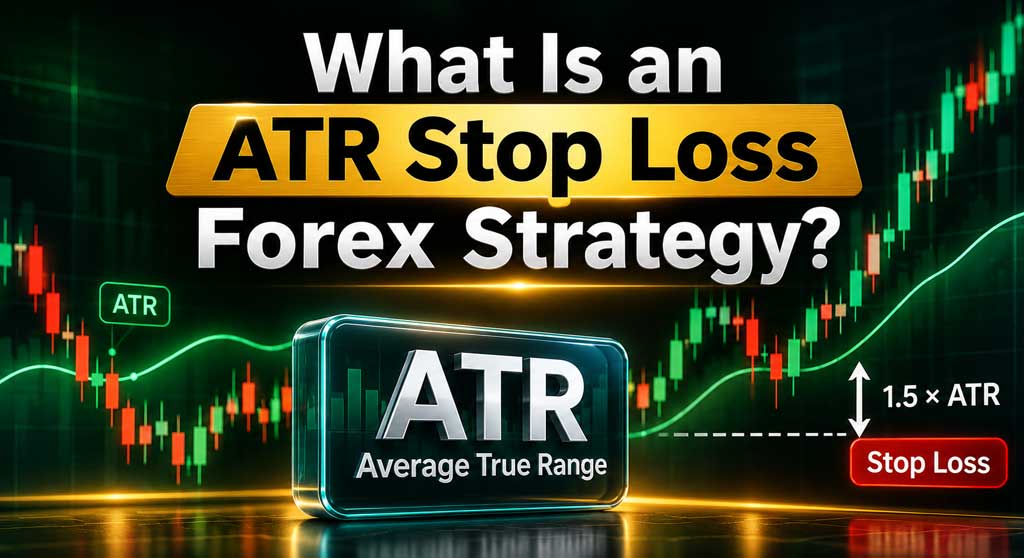
The Average True Range (ATR) is a technical indicator developed by J. Welles Wilder to measure market volatility. Unlike directional indicators, ATR does not identify whether a currency pair will move upwards or downwards. Instead, it measures how much the price has been moving over a selected period. Typically, traders use the 14-period ATR setting to evaluate recent price fluctuations. Nevertheless, shorter periods can respond more quickly to changing market conditions, while longer periods provide a smoother volatility measurement.
The indicator calculates True Range using the greatest of the current high-low range, the absolute difference between the current high and previous closing price, and the absolute difference between the current low and previous closing price. Subsequently, ATR averages these True Range values to estimate recent volatility.
ATR Stop-Loss Calculation:
Stop-Loss Distance = ATR Value × ATR Multiplier
For example, suppose EUR/USD has an ATR reading of 12 pips on the selected timeframe. A trader using a 1.5 ATR multiplier would calculate a stop-loss distance of 18 pips. For a buy position, the stop loss would generally be placed below the entry price. Conversely, for a sell position, it would be placed above the entry price. The advantage is that the stop-loss distance can expand when volatility increases and contract when market movements become quieter. However, ATR should be combined with price structure and position sizing rather than used as an automatic trade-entry signal.
ATR Stop Loss vs Fixed Pips: How Do They Perform Across Different Market Conditions?
The effectiveness of a forex stop loss strategy depends heavily on the trading environment. Therefore, comparing both methods across different volatility conditions provides a more practical understanding of their strengths and limitations.
1. Calm Market Conditions: Why Fixed-Pip Stops Can Be Effective
During calm market conditions, currency pairs often experience relatively narrow price ranges, lower volatility and extended consolidation. For instance, EUR/USD might move within a limited intraday range without significant economic announcements influencing market sentiment. In this environment, fixed-pip stop losses can work effectively because traders can establish a predefined risk distance around a technical entry level. However, ATR-based stops can also provide an advantage by identifying reduced volatility. If the ATR reading decreases, traders may consider a proportionally smaller stop distance, provided that the market structure supports it.
Practical solution: Compare the fixed stop distance with the current ATR reading before entering a position. If the fixed distance is significantly smaller than normal price fluctuations, reconsider the trade rather than placing an unnecessarily tight stop.
2. High-Volatility Markets: Where ATR-Based Stops Have an Advantage
High-volatility conditions frequently occur during major trading sessions, unexpected geopolitical developments, changing interest-rate expectations and significant economic releases. During these periods, currency pairs can experience wider candles, faster price movements and temporary price fluctuations.
For example, a fixed 20-pip stop loss may be insufficient when the pair’s recent ATR indicates substantially wider movements. In contrast, an ATR-based stop can account for the expanded trading range. By increasing the stop distance according to recent volatility, traders can reduce the likelihood of being stopped out by ordinary market fluctuations. Nevertheless, a wider stop also increases the monetary loss if position size remains unchanged.
Practical solution: Calculate the ATR-based stop distance first and then adjust the lot size to maintain the same predefined monetary risk. This approach helps traders avoid increasing account exposure simply because market volatility has increased.
3. News-Driven Markets: Why ATR Alone Is Not Enough
Major economic announcements such as US Non-Farm Payrolls, Consumer Price Index releases, central bank interest-rate decisions and Federal Reserve statements can create sudden forex volatility. During these events, price movements may accelerate within seconds. Furthermore, spreads can widen, liquidity conditions can change and stop orders may experience slippage.
Although ATR reflects recent price ranges, it is a backward-looking indicator. Consequently, it cannot reliably predict the exact size or direction of an upcoming news-driven movement. For example, an ATR reading calculated before an important Federal Reserve announcement may not fully represent the volatility that develops immediately after the announcement.
Practical solution: Combine ATR readings with an economic calendar, spread monitoring and a clear event-risk plan. Depending on the trading strategy, avoiding new positions immediately before major announcements may be more appropriate than simply widening the stop loss.
How to Combine ATR and Market Structure for More Accurate Stop Placement
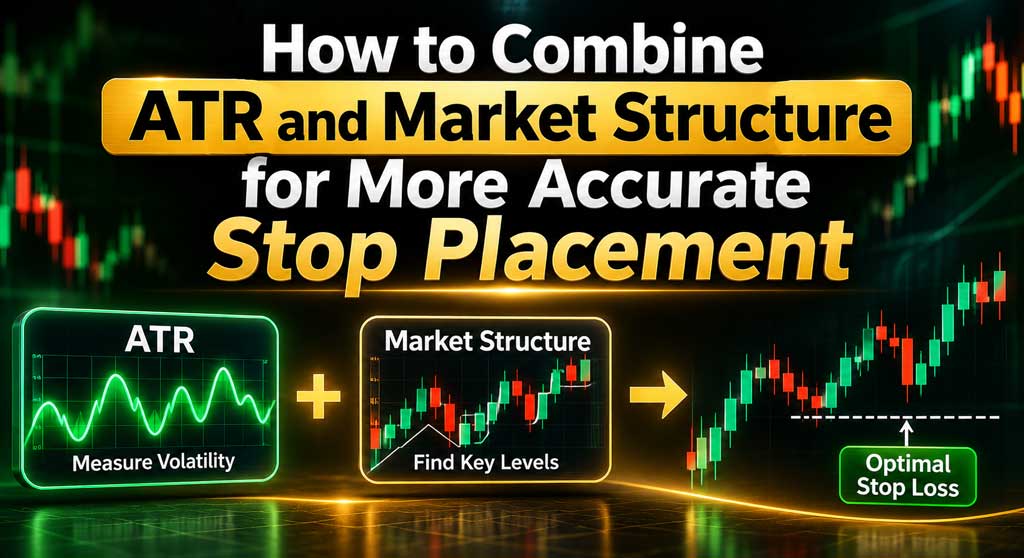
Using ATR independently can create another problem: the stop-loss level might be mathematically appropriate but technically poorly positioned. For instance, placing a stop loss exactly 1.5 ATR below an entry could position it near an important support level, recent swing low or liquidity area. Therefore, experienced traders often combine volatility measurements with technical market structure.
Consider a EUR/USD buy setup where the recent swing low is 1.08200 and the calculated ATR-based stop distance is 20 pips. Instead of blindly applying the indicator, the trader can evaluate whether the stop placement allows sufficient room beyond the relevant support structure. This combination helps distinguish between normal market fluctuations and price movements that may invalidate the original trading setup.
Moreover, traders should calculate position size after identifying the technically appropriate stop distance. As a result, their monetary risk remains controlled even when different trades require different stop distances.
Can AI-Based Algorithms Improve ATR Stop-Loss Decisions?
Traditional ATR calculations provide useful volatility information. However, they do not independently account for every factor influencing currency price movements. An AI-assisted volatility analysis model can potentially improve the decision-making process by evaluating multiple market variables simultaneously. For example, a model can analyse historical ATR readings, current candle ranges, volatility expansion, session activity, spread changes and scheduled economic events.
Using these inputs, an algorithm can classify market conditions into relatively calm, expanding-volatility and event-risk environments. It can then help traders evaluate whether their existing fixed-pip stop distance remains appropriate or whether an ATR-based alternative deserves consideration.
How an AI-Assisted ATR Risk Model Can Work
A practical model can begin by calculating the current ATR and comparing it with its historical average for the same currency pair and timeframe. Next, it can examine the percentage change in ATR to identify whether volatility is increasing or decreasing. Additionally, the algorithm can incorporate market-structure information, including recent swing highs, swing lows and support or resistance zones.
Finally, it can evaluate the proposed stop distance against the trader’s maximum monetary risk and calculate an appropriate position size. For example, if volatility expands while the proposed stop distance increases, the algorithm can recommend a smaller position size to maintain the predefined risk limit. However, AI models do not guarantee accurate predictions or eliminate trading risks. Their usefulness depends on data quality, testing methodology, market conditions and proper human oversight.
Which Forex Stop Loss Strategy Should Traders Choose?
Neither fixed-pip stops nor ATR-based stops are universally superior. The better choice depends on the trading timeframe, currency pair, market conditions and overall risk management framework. Fixed-pip stops can be suitable when traders operate within consistent market conditions and use predefined technical setups. On the other hand, ATR-based stops offer greater flexibility when currency volatility changes frequently. They can help traders adapt their stop distances to recent market behaviour rather than relying on an arbitrary pip value.
For a more advanced approach, combining ATR, market structure, economic-event awareness and disciplined position sizing can provide a more comprehensive risk management process. Ultimately, a successful forex stop-loss strategy is not about avoiding every losing trade. Instead, it is about ensuring that each trade has a logical invalidation level and a clearly defined financial risk.
Frequently Asked Questions About ATR Stop Loss in Forex
Is ATR better than fixed pips for forex stop losses?
ATR can adapt stop-loss distances to changing market volatility, whereas fixed-pip stops maintain a predetermined distance. ATR may be more flexible in changing market conditions, but neither method guarantees better trading results.
What is the best ATR setting for forex stop loss?
The 14-period ATR is a commonly used starting point. However, traders can test shorter settings for more responsive volatility readings and longer settings for smoother measurements. The appropriate setting depends on the trading timeframe and strategy.
What is the best ATR multiplier for forex trading?
Multipliers such as 1.5 and 2 are commonly explored when developing ATR-based stop-loss strategies. However, there is no universally optimal multiplier. Traders should evaluate it using historical testing, market structure and their acceptable risk.
Does ATR predict forex market direction?
No. ATR measures price volatility rather than market direction. It can help traders understand whether price movements are expanding or contracting, but it cannot independently predict bullish or bearish trends.
Can ATR stop losses protect traders during major news events?
ATR can help measure recent volatility, but it cannot reliably anticipate sudden news-driven price movements, liquidity changes or slippage. Therefore, traders should combine ATR with economic-calendar monitoring and appropriate event-risk management.
Build a Smarter Forex Risk Management Strategy with Millance
Choosing the right stop-loss method is only one part of a disciplined forex trading approach. Understanding market volatility, selecting appropriate position sizes and using reliable trading technology are equally important. With Millance, traders can access MT5 trading technology and flexible forex account options designed to support different trading requirements. Explore the forex trading opportunities available through Millance and develop a more structured approach to analysing currency markets.
Take the next step in your forex trading journey.
Visit https://www.millance.com/ and register for free to explore the available forex trading account options.
Risk Disclaimer: Forex trading involves substantial risk and may not be suitable for every investor. Leverage can amplify both profits and losses. Stop-loss orders do not guarantee execution at the requested price during volatile market conditions. Always assess your financial risk before trading.