
Choosing the correct currency lot size is one of the most important decisions a forex trader makes before entering a position. A trade can have a well-defined entry, stop-loss and profit target, yet the position can still carry too much risk if the lot size is calculated incorrectly. The good news is that calculating forex lot size does not have to be complicated. Once you understand the relationship between your account balance, risk percentage, stop-loss distance and pip value, you can determine a position size that matches your trading plan.
This guide explains what forex lot size means, how currency lots work, how to calculate forex lot size, how leverage affects margin, and how to avoid common position-sizing mistakes.
What Is Currency Lot Size in Forex?
A currency lot size represents the number of currency units included in a forex position. In conventional forex terminology, a standard lot represents 100,000 units of the base currency, while a mini lot represents 10,000 units and a micro lot represents 1,000 units. For example, when trading EUR/USD, EUR is the base currency and USD is the quote currency. Therefore, one standard lot represents 100,000 euros.
The practical importance of lot size is straightforward: the larger the position, the larger the monetary effect of every pip movement. For EUR/USD, a commonly used approximation is that one standard lot has a pip value of about $10, while a mini lot is approximately $1 per pip and a micro lot is approximately $0.10 per pip. The exact pip value can vary depending on the currency pair and exchange rate.
Forex Lot Sizes Explained
Understanding the difference between standard, mini and micro lots makes position sizing much easier.
Standard Lot
A standard forex lot represents 100,000 units of the base currency. Therefore, a 1.00-lot EUR/USD position represents 100,000 euros. Because the position is large, even a relatively small price movement can create a substantial profit or loss.
Mini Lot
A mini lot represents 10,000 units of the base currency. Consequently, it provides one-tenth of the exposure of a standard lot. For traders who want smaller position sizes, mini lots can provide more flexibility.
Micro Lot
A micro lot represents 1,000 units of the base currency. As a result, it allows much finer control over position size. For example, a 0.10-lot position corresponds to 10,000 units, while a 0.01-lot position corresponds to 1,000 units when the trading platform uses standard forex lot conventions. However, the available minimum and increment can differ between brokers and instruments, so traders should always check the contract specifications on their trading platform.

Why Forex Lot Size Matters More Than Many Traders Realize
A common trading problem is focusing heavily on the entry price while treating position size as an afterthought. However, two traders can enter the same currency pair at exactly the same price and use the same stop-loss, yet experience completely different monetary outcomes simply because they use different lot sizes.
For example, suppose a trader buys EUR/USD and places a 50-pip stop-loss. If the position is 0.10 lots and the approximate pip value is $1, the planned loss before transaction costs would be around $50. If the trader instead uses 1.00 lot, the same 50-pip movement could represent approximately $500. Therefore, lot size converts a market movement into actual account-level financial impact. This is why position sizing should be calculated before the order is placed rather than selected simply because a particular lot size “looks right” on the trading platform.
How to Calculate Forex Lot Size
The basic forex position-sizing formula is:
Forex Lot Size = Risk Amount ÷ (Stop-Loss in Pips × Pip Value per Lot) First, calculate how much money you are prepared to risk. Then, determine the distance between your entry price and stop-loss in pips. Finally, determine the pip value associated with one lot of the currency pair. For example, suppose a trading account contains $5,000 and the trader chooses a hypothetical 1% risk limit. The maximum planned risk would therefore be:
$5,000 × 1% = $50
Now assume the trade has a 50-pip stop-loss and the approximate pip value for one standard lot of EUR/USD is $10. The position size would be:
$50 ÷ (50 × $10) = 0.10 lots
Therefore, the calculated position size is approximately 0.10 lots, assuming the stated pip-value approximation and excluding spread, commission and slippage. The important point is that the calculation starts with risk and works backward to position size.
How to Calculate Lot Size From Account Balance
Account balance alone does not determine the correct forex lot size. Instead, your balance becomes useful when combined with a predefined risk percentage. Suppose an account has a balance of $2,000 and the trader chooses a hypothetical 1% risk level. The risk amount would be $20. If the stop-loss is 40 pips and the estimated pip value at one standard lot is $10, the calculation becomes:
$20 ÷ (40 × $10) = 0.05 lots
Therefore, the theoretical position size is 0.05 lots. This example demonstrates why simply saying “I have a $2,000 account, so I will trade 0.10 lots” is not a complete position-sizing method. The stop-loss distance changes the amount of market exposure that fits within the same risk amount.

How to Calculate Pip Value for Different Currency Pairs
Pip value is one of the areas where forex lot-size calculations can become confusing. For pairs where USD is the quote currency, such as EUR/USD and GBP/USD, the approximate pip value for a standard 100,000-unit lot is often around $10 when the pair is quoted in conventional decimal terms. However, when USD is not the quote currency, the calculation needs to account for the exchange rate. For example, USD/JPY uses a different pip convention because JPY pairs are normally quoted to two decimal places rather than four. A pip is therefore generally 0.01 for such pairs.
This difference matters because using a fixed $10-per-pip assumption for every currency pair can produce an inaccurate position size. That is precisely why a forex lot size calculator should use the currency pair, account currency, current exchange rate, stop-loss distance and intended risk amount rather than relying on a single universal pip-value assumption.
Current Exchange Rates Can Change Your Calculation
Forex calculations are connected to constantly changing exchange rates. Therefore, a position-sizing calculation using yesterday’s exchange rate may not produce exactly the same result as one using today’s rate. For example, XE’s published historical mid-market data for 18 September 2026 showed EUR/USD at approximately 1.14635, while EUR/INR was approximately 110.05246 at 16:00 UTC. These are historical mid-market reference rates and should not be treated as executable broker prices.
This distinction is important for traders using INR, EUR, GBP or other account currencies because the conversion used for pip-value calculations can change as the market moves. Consequently, a practical calculator should use the latest available price data at the time of calculation rather than a permanently fixed exchange-rate assumption.
Forex Lot Size and Leverage Are Not the Same Thing
Lot size and leverage are closely related, but they describe different things. Lot size determines the position’s trading volume. Leverage determines how much margin may be required to control that position. For example, a trader may open a relatively large notional position while depositing only a fraction of its total market value as margin when leverage is available. However, leverage does not reduce the underlying market exposure. Profit and loss are still calculated from the full position size.
Therefore, increasing leverage should not automatically lead to increasing lot size. A frequent mistake is to see additional available margin and assume that the account can safely support a larger position. In reality, a larger position can increase the monetary impact of every adverse price movement.
A Practical Forex Lot Size Calculation Example
Consider a hypothetical trader with a $10,000 account. The trader chooses a hypothetical 1% maximum risk for the trade, creating a $100 risk amount. The selected currency pair has an estimated pip value of $10 per standard lot, and the technical setup requires a 25-pip stop-loss. The calculation becomes:
Lot Size = $100 ÷ (25 × $10)
Lot Size = 0.40 lots
Therefore, 0.40 lots would theoretically correspond to approximately $100 of planned stop-loss exposure under these assumptions. The calculation should then be checked against the broker’s actual contract specification, spread, commission, minimum volume and available margin before the order is submitted.
What Happens When the Stop-Loss Is Too Wide?
A wider stop-loss does not automatically mean that the trade must be abandoned. Instead, the position size can be adjusted. Suppose the same $100 risk amount is maintained, but the stop-loss increases from 25 pips to 50 pips. The theoretical position size becomes:
$100 ÷ (50 × $10) = 0.20 lots
Therefore, doubling the stop-loss distance while maintaining the same planned monetary risk reduces the position size. This relationship is particularly useful when market volatility increases. Rather than forcing every trade into the same lot size, position sizing can adapt to the actual structure of the setup.
Common Forex Lot Size Mistakes Traders Should Avoid
One of the most common mistakes is selecting a lot size first and calculating the risk afterward. Another is using the same lot size for every currency pair. Because pip values and exchange rates differ, a fixed volume does not necessarily represent the same monetary risk across different instruments. Ignoring the stop-loss is another major issue. A 0.10-lot trade with a 10-pip stop and a 0.10-lot trade with a 100-pip stop do not have the same risk.
Similarly, traders sometimes calculate theoretical risk but forget transaction costs. Spread, commissions and slippage can affect the final trading result, particularly when the stop-loss is relatively tight. Finally, traders should not confuse a deposit bonus or additional available margin with additional risk capital. A promotional balance does not eliminate the market risk associated with the underlying position.
How an AI-Assisted Lot Size Algorithm Can Improve the Calculation
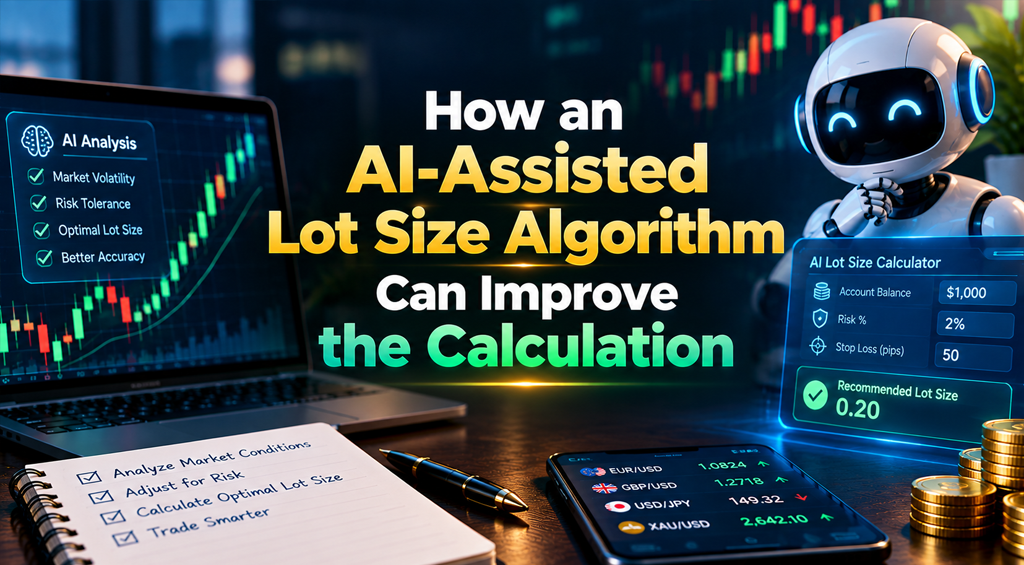
An AI-assisted position-sizing workflow can make the calculation more responsive by processing several variables simultaneously. Instead of relying only on account balance, an algorithm can evaluate account equity, selected risk percentage, stop-loss distance, current currency-pair price, pip convention, account currency, contract specifications and available margin. A simplified algorithm can follow this logic:
Risk Amount = Account Equity × Risk Percentage
Position Size = Risk Amount ÷ Estimated Stop-Loss Cost per Lot
The system can then validate the result against the broker’s permitted minimum and maximum trade volume. However, AI should be treated as a calculation and analysis aid rather than a guarantee of trading success. Market prices can change rapidly, and execution conditions such as spread and slippage can differ from theoretical calculations. For that reason, the final trade should always be checked against the actual trading platform.
Forex Lot Size Calculator: What Should It Calculate?
A useful forex lot size calculator should make the process easier without hiding the underlying calculation. Ideally, a trader should be able to enter the account balance or equity, risk percentage, currency pair, entry price and stop-loss price. The calculator can then determine the stop-loss distance, estimated pip value and corresponding position size. For traders using different account currencies, currency conversion is also important. This approach is more useful than simply providing a list of standard, mini and micro lots because it connects lot size directly to the trader’s intended risk.
How Millance Can Help With Forex Position Sizing
After calculating the appropriate theoretical position size, the next step is to execute the trade through a suitable forex trading environment. Millance provides access to MT5 forex trading, allowing traders to manage forex positions through a professional trading platform. Before opening a live position, traders should verify the applicable contract specifications, spreads, margin requirements and trading conditions for their account.
Millance offers different account structures, including Standard, Elite and Premium accounts, with different minimum deposits, spreads and leverage conditions. Traders should review the applicable account terms before deciding which account structure fits their requirements. You can also use the Millance forex trading account information to compare available trading conditions before registration.
Frequently Asked Questions About Currency Lot Size
What is the best lot size for a forex trade?
There is no single lot size that is appropriate for every trade. The position size depends on account equity, intended risk, stop-loss distance, currency pair and pip value. Therefore, the lot size should be calculated from the trade’s risk parameters rather than selected arbitrarily.
How much is 0.01 lot in forex?
Under the conventional forex lot structure, 0.01 lot represents approximately 1,000 units of the base currency, commonly called a micro lot.
How much is 0.10 lot in forex?
A 0.10-lot position generally represents 10,000 units of the base currency, equivalent to a mini lot under conventional forex terminology.
How many units are in one standard forex lot?
One standard forex lot generally represents 100,000 units of the base currency.
Does leverage change the lot size?
Leverage does not directly change the lot size. Instead, it can change the margin required to open a particular position. The profit and loss remain linked to the position’s full market exposure.
Calculate Your Forex Lot Size Before You Trade
The most important lesson is simple: lot size should follow risk, not emotion. Once you know your account equity, acceptable risk amount, stop-loss distance and pip value, calculating a suitable theoretical position size becomes much more straightforward. At the same time, no calculator can eliminate market risk. Exchange rates move continuously, execution prices can differ from theoretical prices, and trading costs can affect the final result. Therefore, use position-sizing calculations as part of a broader risk-management process.
For traders looking for a structured forex trading environment, explore Millance MT5 forex trading and review the available account conditions before opening a live position.
Ready to calculate your next forex position more precisely? Use a forex lot-size calculation approach that starts with your risk and works backward to your trade volume. Then verify the result on MT5 before placing the order.
Educational note: Forex trading involves substantial risk, particularly when leverage is used. Examples in this article are hypothetical and are provided for educational purposes only. They are not personalized investment advice or a recommendation to enter any particular trade.
Exchange-rate examples in this article are dated reference data, while actual executable prices, spreads, commissions, margin requirements and contract specifications should be verified directly on the relevant trading platform before trading.