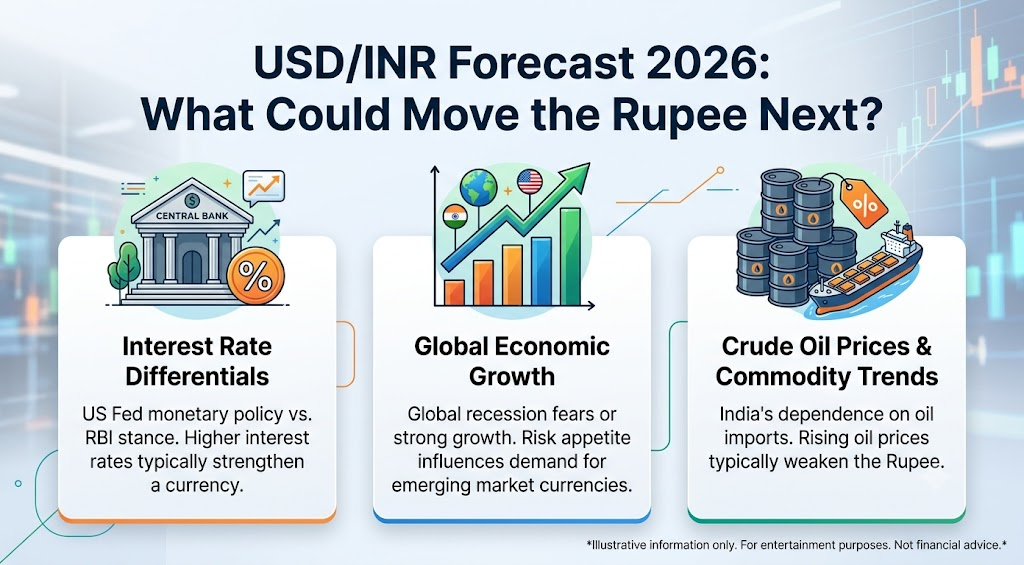

The USD/INR exchange rate has entered another critical phase in September 2026. After the Indian rupee weakened sharply as crude oil moved above $100 a barrel, the currency finished the week around ₹95.55 per U.S. dollar on September 11, according to Reuters. The move has put renewed attention on the USD/INR forecast for 2026, particularly as oil prices, U.S. interest rates, RBI intervention and global risk sentiment converge.
For businesses, importers, exporters and forex traders, the important question is no longer simply whether the rupee will strengthen or weaken. Instead, the bigger question is what could move USD/INR next, and how can traders prepare for those changes? Current market conditions suggest that USD/INR could remain volatile through the remainder of 2026. However, the direction will depend heavily on the interaction between crude oil prices, Federal Reserve policy, Reserve Bank of India intervention, capital flows and inflation.
USD/INR Forecast 2026: Where Does the Rupee Stand Now?
The rupee has recently come under renewed pressure after several weeks of relative stability. On September 11, USD/INR closed around ₹95.55, following a weekly decline of approximately 1.1%. At the same time, Brent crude remained above $100 per barrel, creating additional pressure on India’s import bill. This matters because India remains highly dependent on imported crude oil. Therefore, when oil becomes more expensive, Indian importers generally need more U.S. dollars to pay for energy purchases. Consequently, higher oil prices can increase demand for dollars and put downward pressure on the rupee.
Moreover, the Reserve Bank of India has been actively managing excessive currency volatility. Recent reports indicate that state-owned banks were selling dollars and the RBI was using dollar-rupee swaps to manage liquidity and support the currency. As a result, traders should not interpret every move toward ₹96 or beyond as a straight-line depreciation trend. RBI intervention can significantly influence the pace and structure of USD/INR movements.
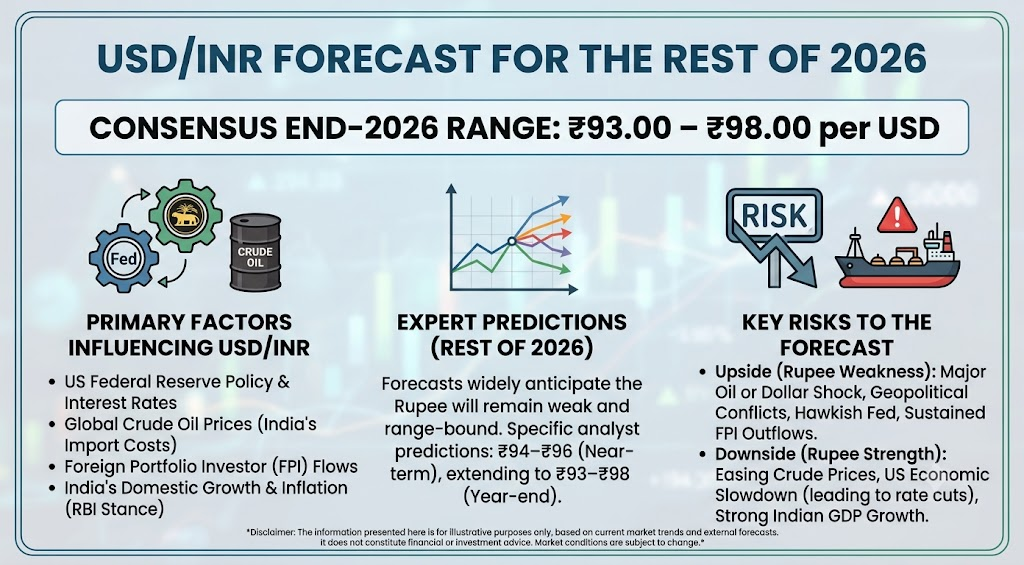
What Is the USD/INR Forecast for the Rest of 2026?
The current outlook points toward continued volatility with an upward risk for USD/INR, particularly if crude oil remains elevated and U.S. interest rates stay higher for longer. MUFG recently projected USD/INR around 95.50 by Q4 2026, while expecting the pair to move toward 96.50 by Q2 2027. That forecast is particularly relevant because it incorporates continued structural dollar demand, portfolio flows, corporate repatriation and import requirements.
However, forecasts should not be treated as fixed targets. Currency markets react to new information continuously. Therefore, a better way to approach the USD/INR forecast is through scenarios. If oil prices decline and global risk sentiment improves, the rupee could regain some ground. Conversely, if crude remains above $100, U.S. yields increase and the Federal Reserve maintains a restrictive stance, USD/INR could remain under upward pressure.
For traders, therefore, ₹95–₹96 becomes an important area to monitor rather than assuming a single guaranteed year-end price.
Why Crude Oil Could Be the Biggest Rupee Driver
Crude oil is one of the most important variables in the USD/INR outlook. Recently, Brent crude moved above $100 per barrel amid escalating Middle East tensions and concerns surrounding global oil supply. Reuters reported that the rise in energy prices has increased pressure on oil-importing economies such as India. The mechanism is relatively straightforward. When crude becomes more expensive, India’s import bill can rise. Importers consequently require more dollars. Increased dollar demand can then place pressure on the rupee.
Furthermore, higher oil prices can increase domestic inflation. India’s August wholesale inflation reached 9.92% year over year, with fuel and power prices rising particularly sharply. Therefore, traders watching USD/INR should monitor crude oil alongside the currency rather than analysing the dollar-rupee chart in isolation.
How Federal Reserve Interest Rates Could Move USD/INR
The second major driver is the Federal Reserve. The U.S. federal funds target range currently stands at 3.50%–3.75%, while inflation remains above the Federal Reserve’s 2% objective. Recent U.S. August CPI data showed consumer prices rising 3.4% annually, while core CPI increased 2.4%. Consequently, markets have increased expectations of a potential Federal Reserve rate hike at the September meeting. Reuters reported that market pricing had moved toward an approximately 87% probability of a September hike following stronger-than-expected inflation data and rising energy prices.
A higher U.S. interest-rate environment can support the dollar because U.S. assets may become relatively more attractive. Consequently, emerging-market currencies, including the rupee, can face additional pressure. However, the relationship is not automatic. If the Federal Reserve becomes more dovish later in the year, U.S. yields could decline and the dollar could weaken. In that situation, USD/INR could receive downward pressure.
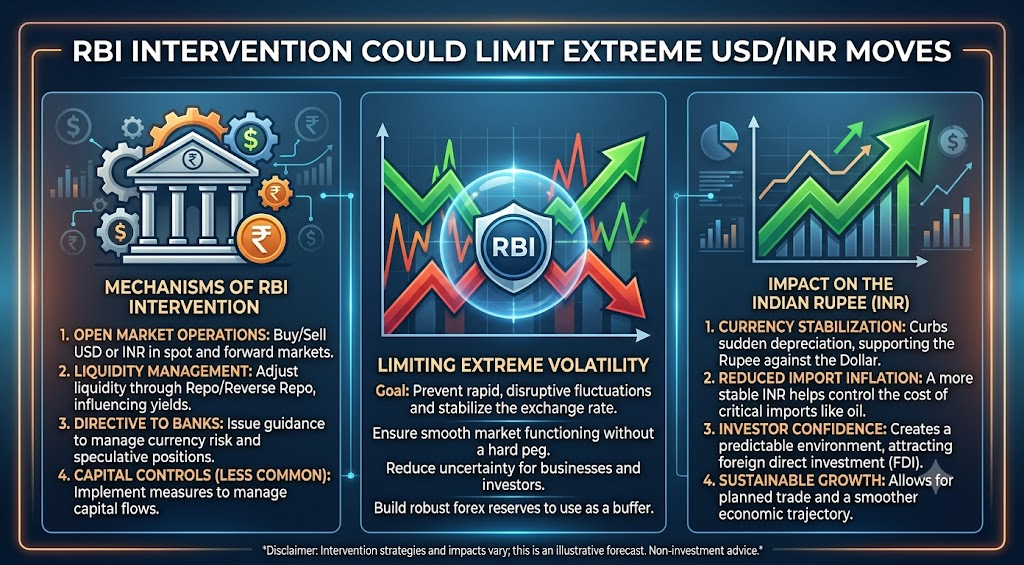
RBI Intervention Could Limit Extreme USD/INR Moves
While global factors influence USD/INR, the RBI remains an important domestic force. Recent market activity shows that the central bank has been using foreign-exchange intervention and sell-buy swaps to manage liquidity and reduce excessive currency volatility. Reuters reported that RBI-related dollar selling was observed as the rupee came under pressure from higher oil prices and U.S. bond yields.
This creates an important distinction for traders. The RBI does not necessarily need to establish a permanent exchange-rate level. Instead, intervention can help prevent disorderly movements and excessive short-term volatility. Therefore, a sudden USD/INR spike may encounter resistance if the central bank considers the move excessively volatile. Nevertheless, intervention cannot permanently eliminate fundamental pressures caused by oil prices, capital flows or global monetary policy.
Indian Inflation Adds Another Layer to the USD/INR Outlook
Inflation is becoming increasingly important for the rupee outlook. India’s August consumer inflation was expected to rise to approximately 4.8%, according to a Reuters economist poll, compared with 4.45% in July. The increase was linked partly to food and fuel pressures. At the same time, wholesale inflation reached 9.92%, showing considerably stronger price pressure at the producer level.
If inflation remains elevated, the RBI could have less room to ease monetary policy aggressively. In contrast, stabilising inflation would provide policymakers with greater flexibility. For USD/INR traders, the key issue is therefore not simply the inflation number itself. Instead, traders should consider whether inflation is changing the expected path of RBI policy.
AI-Based USD/INR Forecasting: What Should Traders Watch?
Traditional forecasting often focuses on one or two variables. However, an AI-assisted USD/INR forecasting model can combine multiple market signals to create a more dynamic scenario analysis. A practical AI model can assign changing weights to crude oil, DXY strength, U.S. Treasury yields, RBI intervention, Indian inflation, interest-rate differentials, foreign portfolio flows, USD/INR momentum and geopolitical risk.
For example, if crude oil rises sharply while U.S. yields also increase, the model could increase the probability of upward USD/INR pressure. Conversely, if oil falls, the dollar weakens and foreign capital flows improve, the model could increase the probability of rupee appreciation. Importantly, AI should not be presented as a machine that knows the future. Instead, it should be used as a probability and scenario-analysis tool. That approach is particularly useful because currency markets can change rapidly after unexpected central-bank decisions, economic releases or geopolitical events.
What Could Push USD/INR Above ₹96?
A sustained move above ₹96 could become more likely if several negative factors occur together. For example, persistent crude prices above $100 could increase India’s import demand for dollars. At the same time, a hawkish Federal Reserve could strengthen the U.S. dollar and increase Treasury yields. Additionally, weaker foreign portfolio flows could further reduce demand for Indian assets.
There is also a structural risk from unhedged foreign-currency exposures. Reuters recently reported that Indian banks had left significant FX exposure associated with overseas deposits unhedged, creating a potential source of additional dollar demand if the rupee weakens sharply. Therefore, traders should watch the ₹96 area carefully, particularly if oil and U.S. yields rise simultaneously.
Could the Rupee Recover in 2026?
Yes. A stronger rupee remains possible if the major pressures begin to reverse. A decline in crude oil prices would immediately improve India’s external trade dynamics. Similarly, lower U.S. inflation could reduce expectations for further Federal Reserve tightening and weaken the dollar. At the same time, stronger foreign investment into Indian equities and bonds could increase dollar supply. RBI intervention could further reduce short-term volatility.
Consequently, the USD/INR outlook should remain two-sided rather than permanently bearish on the rupee. The biggest mistake traders can make is assuming that a currency trend must continue simply because it has been strong recently.
USD/INR Forecast 2026: Key Levels and Market Signals
With USD/INR recently around ₹95.55, traders should focus on price behaviour around major psychological levels rather than relying exclusively on long-term forecasts. The ₹95 area is important because sustained trading above it indicates continued dollar strength against the rupee. Meanwhile, ₹96 becomes a significant psychological and technical area if upward momentum continues.
On the downside, a sustained move back below ₹95 could signal that selling pressure is easing. However, confirmation would ideally come from supporting fundamentals such as falling oil prices, softer U.S. yields or improved foreign capital flows. Therefore, combining technical price action with fundamental data can provide a more reliable decision-making framework than using either approach alone.
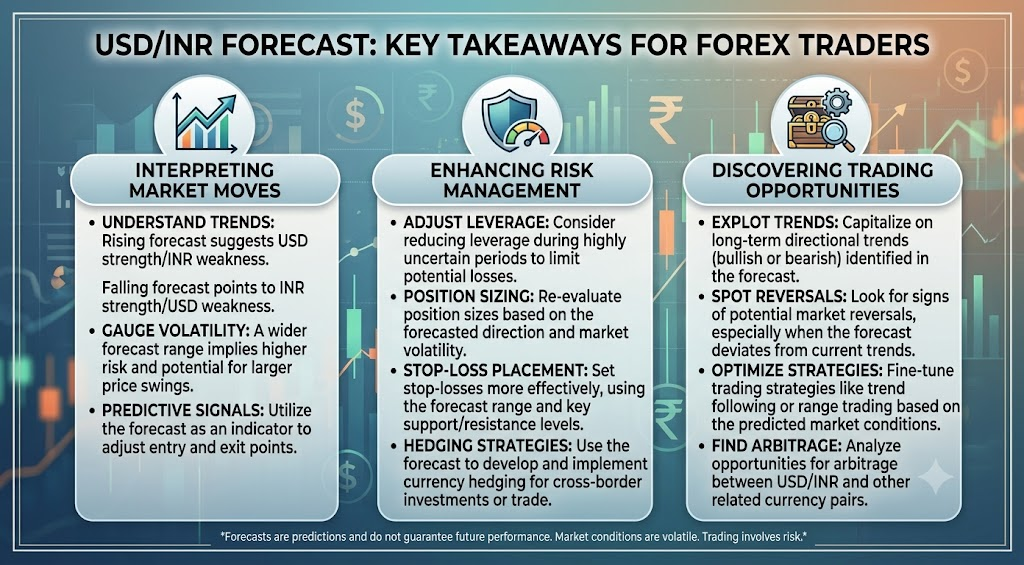
What Does the USD/INR Forecast Mean for Forex Traders?
For forex traders, the current environment creates both opportunity and risk. Higher volatility can create more trading setups. However, it can also increase the speed at which a position moves against the trader. This is particularly important around Federal Reserve announcements, RBI decisions, U.S. inflation releases, Indian inflation data and major crude-oil developments. Rather than entering trades solely because USD/INR appears bullish or bearish, traders can use economic-calendar events, technical confirmation and risk-management rules to make more disciplined decisions. For traders looking to access global forex markets, having a reliable trading environment and real-time market information becomes increasingly important when volatility rises.
USD/INR Forecast 2026: Final Outlook
The USD/INR forecast for 2026 remains highly sensitive to crude oil, Federal Reserve policy, RBI intervention, inflation and global capital flows. As of September 2026, the rupee is facing renewed pressure after USD/INR moved around ₹95.55 and crude oil climbed above $100. At the same time, the RBI continues to use market operations to limit excessive volatility, while expectations surrounding U.S. interest rates have become more uncertain.
The most reasonable conclusion is therefore not a single fixed USD/INR target. Instead, traders should prepare for continued volatility around the ₹95–₹96 region, while monitoring whether oil prices, U.S. yields and central-bank policies confirm or challenge the current trend. The next major USD/INR move could ultimately be determined not by one economic indicator, but by how several of these forces interact.
Stay ahead of major forex market movements with real-time market analysis, economic events and professional trading tools. Explore Millance’s forex trading platform and access MT5 for your trading needs.
Explore Millance Forex Trading
Frequently Asked Questions About USD/INR Forecast 2026
What is the USD/INR forecast for 2026?
The USD/INR outlook remains volatile, with recent market conditions pointing toward continued pressure on the rupee. MUFG’s latest published forecast sees USD/INR around 95.50 by Q4 2026.
What could make USD/INR rise in 2026?
Higher crude oil prices, stronger U.S. interest rates, elevated U.S. Treasury yields, weaker foreign capital flows and increased dollar demand could push USD/INR higher.
Can the Indian rupee strengthen against the U.S. dollar?
Yes. Lower oil prices, weaker U.S. dollar conditions, stronger foreign investment flows and RBI support could help the rupee recover.
Is USD/INR likely to remain volatile?
Yes. Oil prices above $100, uncertainty around Federal Reserve policy and geopolitical risks can create substantial short-term volatility in USD/INR.
How can traders monitor USD/INR?
Traders can combine live USD/INR price action with crude oil, U.S. interest rates, Indian inflation, RBI announcements, Federal Reserve decisions and economic-calendar events to develop a more complete market view.
Conclusion: What Could Move USD/INR Next?
The USD/INR forecast for 2026 remains closely tied to a combination of crude oil prices, U.S. interest-rate expectations, RBI intervention, inflation, foreign investment flows and global risk sentiment. With USD/INR recently trading near the ₹95–₹96 region, the rupee continues to face pressure, particularly while elevated oil prices increase India’s dollar demand.
However, the direction of USD/INR is unlikely to depend on a single factor. If crude oil prices remain elevated and U.S. yields stay firm, the dollar could retain an advantage against the rupee. On the other hand, falling oil prices, improving foreign capital inflows, a softer U.S. dollar and supportive RBI measures could create room for the rupee to recover.
Therefore, traders and businesses should avoid relying on a fixed year-end USD/INR prediction. Instead, monitoring live price action, economic data, RBI and Federal Reserve decisions, crude oil movements and market sentiment can provide a more practical view of where the currency could move next.
AI-assisted market analysis can further help by combining these variables and identifying changing probability scenarios. Nevertheless, AI forecasts should complement—not replace—market research, technical analysis and disciplined risk management.
For forex traders, periods of higher USD/INR volatility can create new opportunities, but they also require faster decisions and appropriate risk controls. Keeping track of major economic events and using a professional trading environment can help traders respond more effectively as market conditions change.
Want to stay prepared for the next major forex move? Explore Millance and access MT5 forex trading with real-time market conditions, competitive trading features and a professional trading environment.